
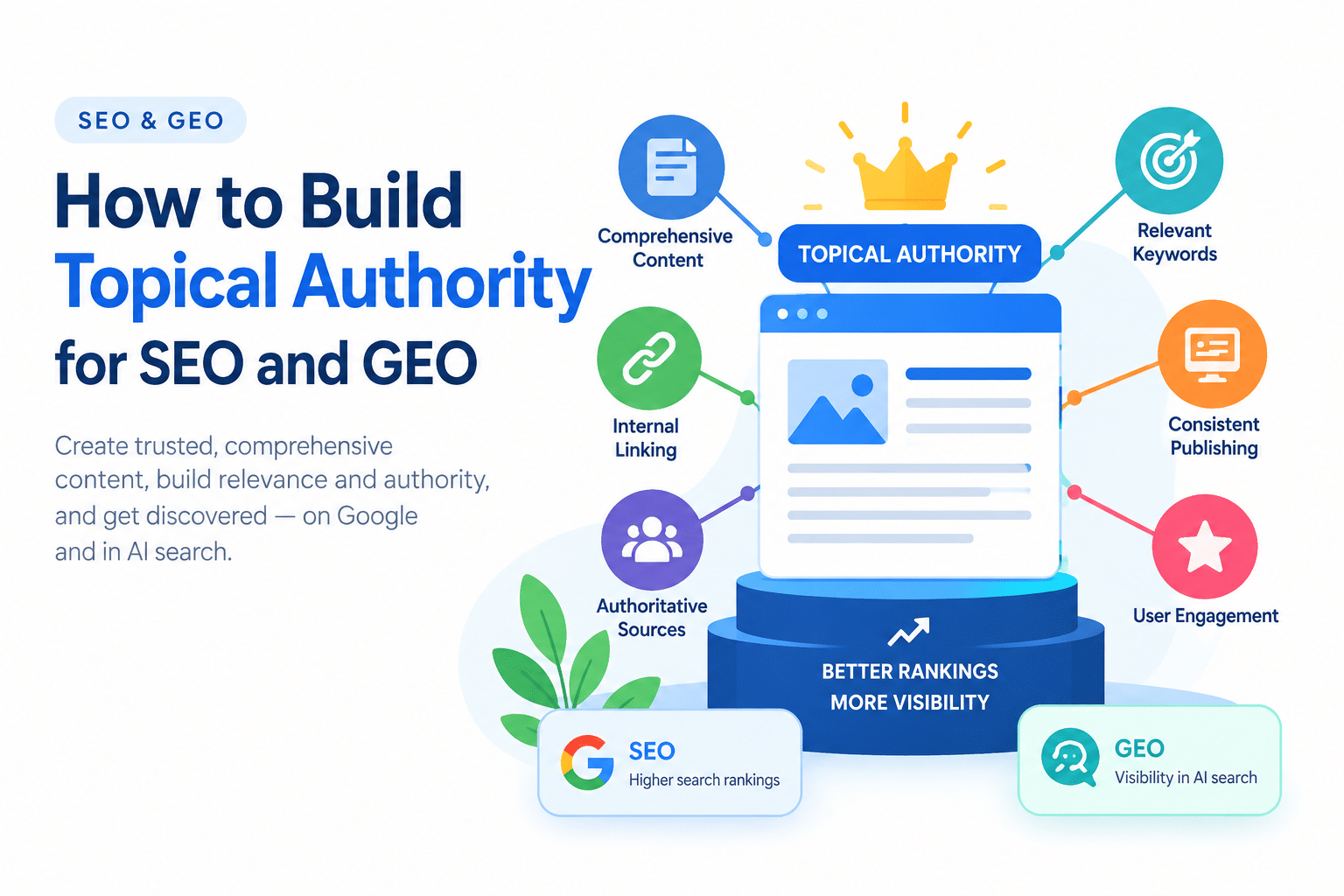
Topical authority describes how strongly and comprehensively a website covers a specific subject. It is a popular term in SEO, but it is not a score you will find in Google Search Console. It is more useful to see it as a way of organising your content strategically: you consciously decide which topics matter, which questions deserve their own page, and how those pages connect to one another.
That is what makes topical authority so practical. A good structure stops several articles from telling the same story, and it ensures that important subjects are covered in enough depth.
The same approach matters for GEO (Generative Engine Optimisation). Generative search experiences such as Google AI Overviews, ChatGPT and Perplexity answer detailed questions by drawing on information from many sources. A website with clearly defined topics is easier for visitors to navigate, and also easier for search engines and AI systems to understand.
For Indian businesses this matters even more. Indian users search in English, Hindi, Hinglish and regional languages, and they often ask long, conversational questions such as “GST registration kaise kare” or “best term insurance for a 30-year-old in India“. A well-structured site gives each of these questions a clear home.
Choose a clear main topic
A strong content cluster does not start with as many keywords as possible. It starts with one question: what does your organisation actually want to be known for?
A subject like “online marketing” is so broad that almost every digital discipline falls under it. Topics such as SEO, conversion optimisation or AI automation are far easier to define and own.
Your main topic must align with your services and expertise. If you publish lots of content about something your business does not offer, you may gain traffic but not a stronger commercial position. For example, a Jaipur-based CA firm will gain more from owning “GST compliance for small businesses” than from writing general articles on personal finance.
You also need enough original knowledge to go beyond the generic information already available on dozens of other websites. Your own client experience, local regulations and real case examples are what set your content apart.
A good SEO approach therefore begins by deciding which topics you want to be visible for, and what role those topics play in the customer journey. Search volume can help you set priorities (a keyword volume checker gives a quick estimate), but it should never be the only reason to build a cluster.
Create a content map first
Once your main topic is settled, it is tempting to brainstorm titles and start writing straight away. A content map created beforehand prevents a common problem: after a few months, you end up with several pages answering roughly the same question.
Start with the questions already circulating within your organisation:
- What questions does your sales team hear regularly?
- What challenges do customers face during projects?
- Which topics do you find yourself explaining again and again?
Combine this knowledge with existing search data. Where needed, use keyword research tools such as Google Search Console, Google Keyword Planner, Ahrefs or Semrush to find additional topics and search intents. Our keyword research guide walks through the process step by step. Do not ignore Hindi and Hinglish variations, as many Indian users search that way.
Next, group the questions by user need. Someone who wants to know what GEO means has different needs from someone who wants to know how GEO is measured. A strong content marketing strategy gives both exploratory and commercial questions a logical place within the whole.
Decide which questions deserve their own page
Not every search query needs a separate page. Two different search terms can represent the same information need. If you write a separate article for each, the pages are likely to overlap.
A practical check is to compare the search results for both queries. Take “SEO company in India” and “SEO agency in India” as an example. If Google shows largely the same pages for both, one strong page can probably serve both queries. If the results clearly answer different needs, a separate page makes more sense.
Always combine this check with your own judgement. Can the page answer a clear question on its own, and does it have its own role within the cluster? If so, there is probably good reason for a separate page. Good SEO copy starts not just with a keyword, but with a clear promise to the reader.
Prevent pages from competing for the same topic
Even a well-planned cluster can develop overlap over time. An existing article gets expanded, new content is added, or different writers unknowingly target the same search intent. It then becomes unclear which page should provide the main answer.
Google Search Console can help you spot this. When different URLs regularly receive impressions for the same important query, the pages may be too similar. This is not automatically a problem, but it is a good reason to compare them side by side.
If two pages truly serve the same purpose, you have three options:
- Merge them into one clear master version and redirect the weaker URL.
- Sharpen their focus so that each page answers a different question.
- Remove the page if it turns out to have no real function of its own.
Use internal links to support the structure
Internal links are an important part of a content cluster. However, simply connecting many pages does not build authority. Their value lies in the context they provide and the path they create for visitors.
The anchor text should make it clear what the next page is about. A natural reference to ways to rank your website higher in Google tells readers and search engines far more than generic text like “click here”. The link should also appear at the moment the follow-up question naturally arises.
Within a cluster, links work in several directions:
- Supporting articles link back to the main (pillar) page.
- The pillar page directs visitors to in-depth articles.
- Related articles link to each other when there is a clear thematic connection.
Example: a GST content cluster for an Indian CA firm
Imagine a CA firm in Pune that wants to be known for GST compliance for small businesses. Instead of writing dozens of loosely related blogs, it plans one pillar page and five supporting pages, and each page owns a single question.
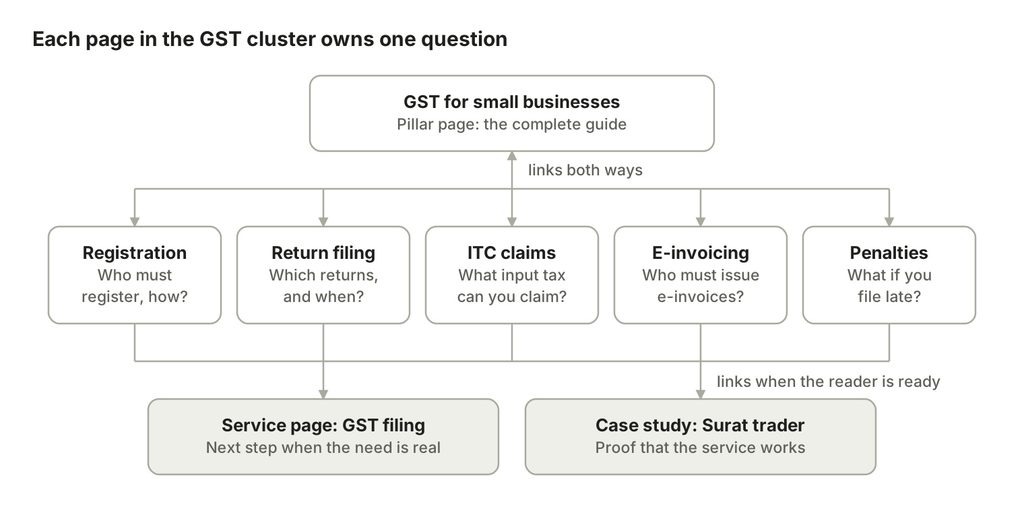
The pillar page links down to every supporting page, and each supporting page links back up. When a reader is ready to act, the supporting pages link to the GST filing service page and a client case study.
New ideas are checked against this map before anyone writes. “GST registration documents” and “how to register for GST online” would likely be answered on the existing Registration page, if Google shows largely the same results for both. A genuinely new question, such as GST on exports, would get its own supporting page.
Don’t build only informative content
A cluster made up only of explanations can attract many relevant visitors, but it often lacks a link to the rest of the customer journey. Someone who first wants to understand topical authority may later want to know how to implement it, or which SEO consultant or agency can help.
Informative and commercial pages must therefore work together. Informative content answers questions and demonstrates expertise. Service pages, case studies and other in-depth pages then give the visitor a logical next step when their need becomes more concrete.
Take an online coaching institute preparing students for UPSC. Its blogs on the syllabus and exam pattern attract aspirants, while course pages, faculty profiles and success stories help them decide to enrol.
This does not mean every blog must sell something. The strength lies in the coherence. An article should first answer its own question well, and only then point to the next step when it is relevant to the reader.
Example: Jagdish Prajapat’s SEO and GEO cluster
While building our own SEO and GEO cluster, we ran into exactly the problem a content map is meant to prevent. During writing, our articles on the difference between SEO and GEO, GEO optimisation and GEO measurement began covering the same topics in different places.
Measurement, for example, appeared in the general GEO article and again in detail in the optimisation article. Off-site visibility showed up in several places, and the explanation of generic AI content also started to overlap. Had we published them that way, multiple pages would have partly owned the same question.
So we redefined which page owns which section:
- GEO optimisation focuses on implementation.
- GEO measurement covers KPIs and the measurement method.
- This article explains the structure in which these pages come together.
Other pages can briefly mention a topic when needed, but the detailed explanation stays in one fixed place.
In practice, this is a key part of topical authority. It is not just about deciding what else to write about. It is mainly about deciding which page owns which question.
Keep the cluster active
A content cluster is not finished once all the planned articles are live. Search behaviour changes, services evolve, and new topics can start to overlap with existing pages. Without maintenance, overlap slowly creeps back in.
Indian search trends shift quickly. Changes to income tax slabs in the Union Budget or new RBI guidelines, for instance, can make a finance article outdated overnight.
A periodic review helps you see which pages still perform well, which information is outdated, and where articles are drifting in the same direction. Sometimes improving an existing page is more valuable than publishing a new one; our on-page optimisation guide shows where to start. That way, the quality of the cluster keeps growing without the website becoming unnecessarily large and complex.
During a review, do not look at rankings alone. Impressions, traffic, internal links, conversions and new search queries together give a better picture of where the cluster still has potential. Once GEO is part of your strategy, also track which topics and pages appear in generative search experiences.
Topical authority also helps with GEO
You do not need a separate content structure for GEO alongside your SEO strategy. A clear cluster, with well-defined topics, answered questions and visible expertise, already forms a useful information base for generative search.
This does not guarantee that your website will be cited in Google AI Overviews, ChatGPT or any other AI tool. Which sources are selected depends on the platform, the query and the information available. What you can control is how clearly and completely your own knowledge is available online.
Topical authority is therefore mainly a way to create structure. SEO and GEO are not separate content projects, but different forms of visibility built on the same content foundation.
Want your brand to appear in AI-generated answers? Explore our AI SEO services and AEO services to get your expertise visible in Google AI Overviews, ChatGPT and Perplexity.
Build a content system that can grow
Topical authority does not come from publishing as many blogs as possible around one keyword. It comes from consciously choosing which topics matter, clearly defining the questions within them, and giving every page a clear function.
So start small:
- Develop one strong main topic.
- Check where overlap occurs.
- Improve existing pages before adding new ones.
- Once the structure works, repeat the process for the next topic.
At Jagdish Prajapat, our SEO approach brings together research, content, technology and automation. The result is a website that grows not just in the number of pages, but above all in the quality and coherence of its information.
Ready to build topical authority for your website? Schedule a consultation to map your first content cluster, or see the SEO results we have delivered for clients.
Frequently asked questions about topical authority
Is topical authority a ranking factor?
Topical authority is not a Google score that you can measure or optimise directly. In SEO, the term is mainly used to assess how well a website covers a subject and how coherent its content is. Stronger, better-organised content can improve your visibility, but there is no button to directly increase topical authority.
How many pages does a good content cluster need?
There is no fixed number. It depends on the scope of the subject and the questions your target audience asks. If you feel you need dozens of pages before the most important questions are covered, your main topic may be too broad.
How do you recognise content that competes with itself?
A common signal is that several pages receive impressions for the same important search query while giving almost the same answer. In that case, compare the pages on search intent, content and role within the cluster. If the difference is not clear enough, merging them or defining each page more sharply is often the better solution.
Does topical authority also work for GEO?
Yes. A clear, substantive website structure is also valuable for GEO, because information is better defined and your expertise is easier to see. It does not guarantee a mention in an AI-generated answer, but it does create a stronger information base on which every form of online visibility can build.
