
Search changed more between 2024 and 2026 than in the ten years before. Google still handles most searches, but AI Overviews, AI Mode and ChatGPT now answer many questions before anyone clicks a link. Many SEO statistics still shared online are from 2019 or 2020, so they no longer describe how people search.
This list contains only figures published by the original researcher, or by Google or OpenAI themselves, and each one shows its source and date. Where no newer research exists, the date makes that clear. Because I work with businesses in India, I’ve added a section of India-specific data you won’t find in most global roundups.
Key takeaways
- Google still dominates with 88.67% of global search share and more than 5 trillion searches a year.
- AI answers are everywhere: AI Overviews reach more than 2.5 billion monthly users, and AI Mode more than 1 billion.
- Clicks are getting scarcer: when an AI Overview appears, the #1 result gets 58% fewer clicks.
- AI referrals are growing fast but are still small, at 0.32% of all website traffic.
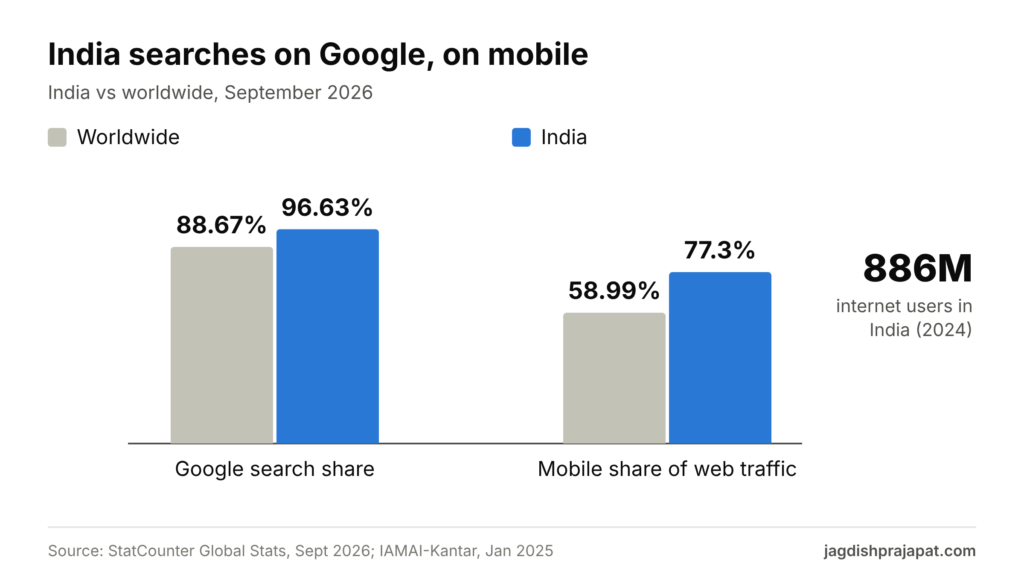
- India is even more Google- and mobile-first: Google has 96.63% of search in India, and 77.3% of web traffic comes from mobile.
Search engine market and search volume
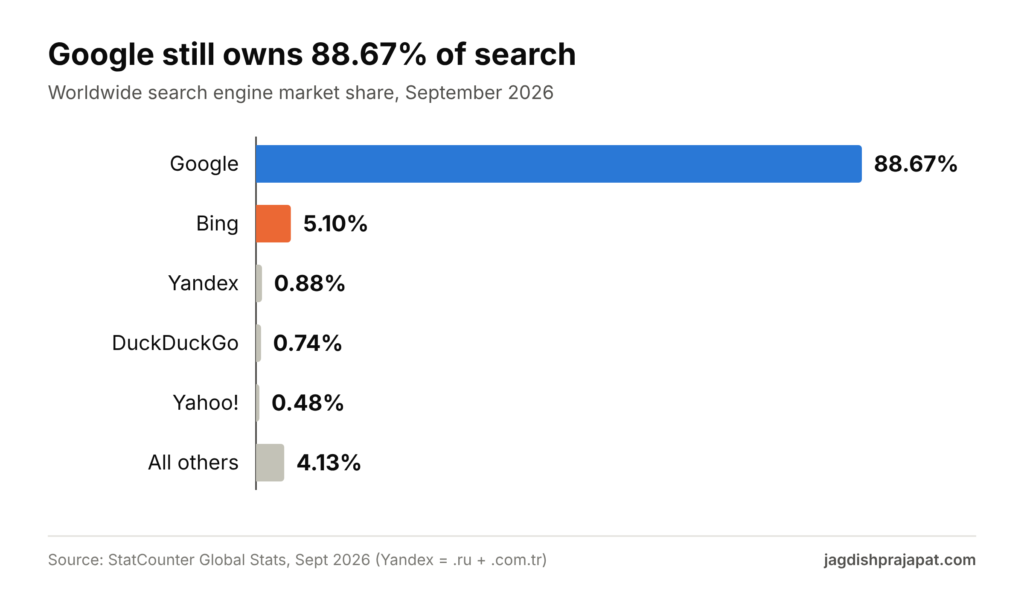
1. Google holds 88.67% of the global search market. Bing is second with 5.1%.
DuckDuckGo (0.74%), Yandex and Yahoo! each hold under 1%. For most businesses, optimising for Google is still where the traffic is, but Bing is worth covering too, because its index also feeds some AI search tools.
Source: StatCounter Global Stats, September 2026
My take: Verify your site in Bing Webmaster Tools as well as Google Search Console. It takes ten minutes, and Bing data shows you how visible you are to the AI assistants that draw on its index.
2. Google handles more than 5 trillion searches a year, which works out to roughly 14 billion a day.
This was Google’s first official volume figure since 2016, when it said “more than 2 trillion”. AI chat tools have not reduced overall search demand.
Source: Google, via Search Engine Land, March 2025 (the daily figure is Search Engine Land’s estimate)
3. 15% of searches on Google every day are queries it has never seen before.
Google’s John Mueller said the figure has stayed at about 15% for years, even with AI tools in the mix. New questions keep appearing, which gives fresh content a way to rank.
Source: Search Engine Journal, March 2025
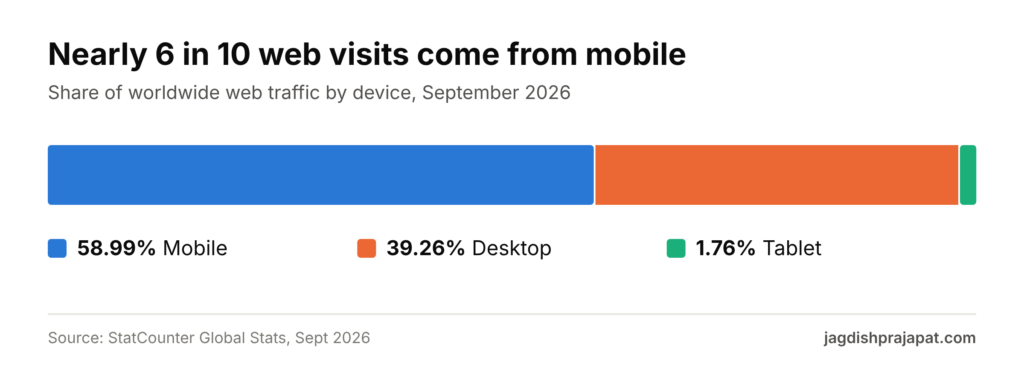
4. Mobile devices account for 58.99% of global web traffic, desktops 39.26% and tablets 1.76%.
Google indexes the mobile version of your site first, so check speed, layout and content on a phone before a laptop.
Source: StatCounter Global Stats, September 2026
5. Google Lens handles more than 25 billion visual searches a month, and 1 in 5 has commercial intent.
Product photos, image alt text and Merchant Center feeds now directly affect whether people can find your products.
Source: Think with Google, published June 2026 (Google internal data, April 2025)
AI search
6. Google’s AI Overviews have more than 2.5 billion monthly active users.
The figure was up from 2 billion in mid-2025. For many informational queries, the AI Overview is now the first thing people see.
Source: Google, updated August 2026My take: Search your 10 most important keywords and note which ones show an AI Overview and which sites it cites. That list tells you where to focus AI SEO work first: pages that rank but aren’t cited are your quickest wins.
7. Google’s AI Mode passed 1 billion monthly users within a year of launch.
Google says AI Mode queries have more than doubled every quarter since launch.
Source: Google I/O 2026 recap, May 2026
8. ChatGPT has 900 million weekly active users, up from 800 million in October 2025.
Your brand now also needs to be visible in AI chat answers, alongside Google.
Source: OpenAI, via TechCrunch, February 2026
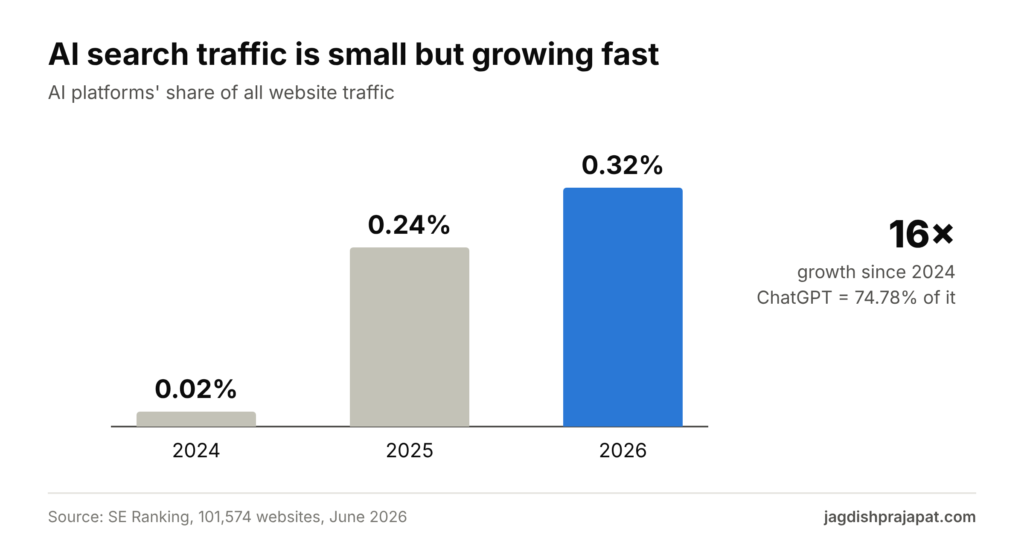
9. AI search platforms send just 0.32% of all website traffic, but that is 16 times more than in 2024.
That is about one visit in every 312. Organic search from Google is still far larger, but AI referrals are the fastest-growing source.
Source: SE Ranking, 101,574 websites, June 2026
My take: Set up a custom channel group in GA4 for chatgpt.com, perplexity.ai, gemini.google.com and copilot.microsoft.com. Without it, most AI visits get filed under “Referral” or “Direct”, and you can’t see the trend.
10. ChatGPT drives 74.78% of all AI referral traffic.
Its share fell from 79.74% in 2025 because other AI platforms grew faster, but ChatGPT’s own referral traffic still rose 27% year on year.
Source: SE Ranking, June 2026
Clicks, CTR and zero-click search
11. When an AI Overview appears, the #1 organic result gets 58% fewer clicks.
Ahrefs compared 300,000 keywords from December 2023, before AI Overviews launched, with the same keywords in December 2025. Its 2025 study measured a 34.5% drop, so the effect has grown.
Source: Ahrefs, February 2026
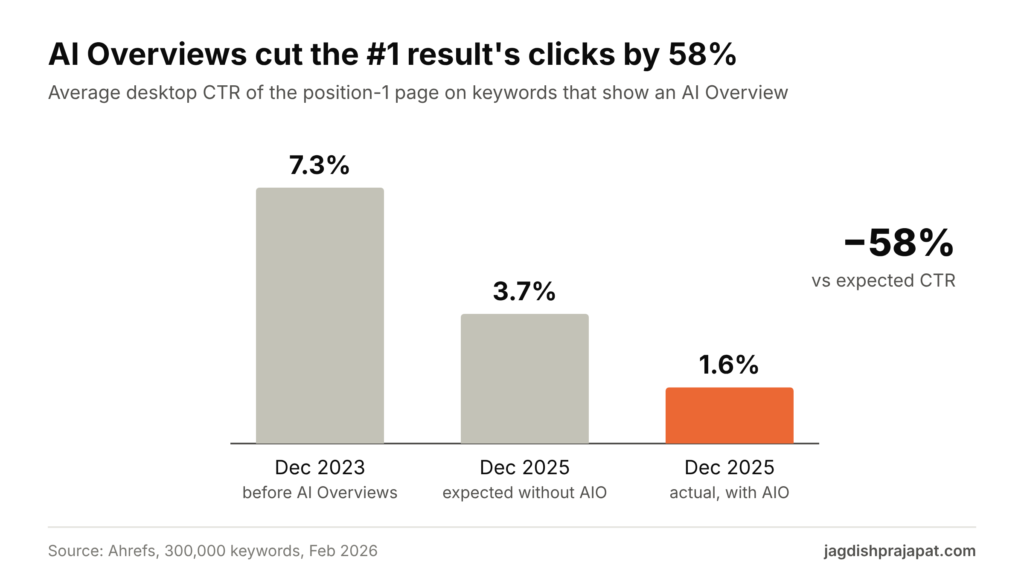
My take: Don’t judge a page by rankings alone any more. If its impressions are steady but its clicks are falling in Search Console, an AI Overview is the likely cause. Give that page a stronger reason to click: a calculator, a template, or original data the summary can’t reproduce.
12. Users click a regular search result in 8% of visits when an AI summary appears, compared with 15% when there is none.
Pew tracked the real browsing behaviour of 900 US adults across 68,879 Google searches.
Source: Pew Research Center, via TheWrap, July 2025
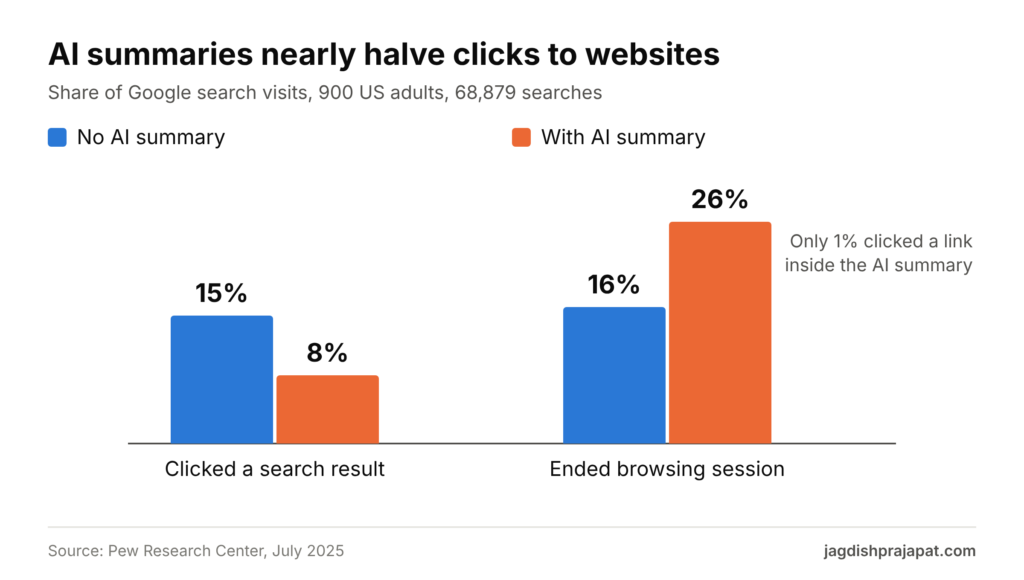
13. Only 1% of visits to a results page with an AI summary included a click on a link inside the summary.
Being cited in an AI Overview helps your brand get noticed, but on its own it brings very little traffic.
Source: Pew Research Center, via TheWrap, July 2025
14. Users ended their browsing session on 26% of results pages with an AI summary, against 16% of pages without one.
More people get their answer and leave without visiting any website.
Source: Pew Research Center, via TheWrap, July 2025
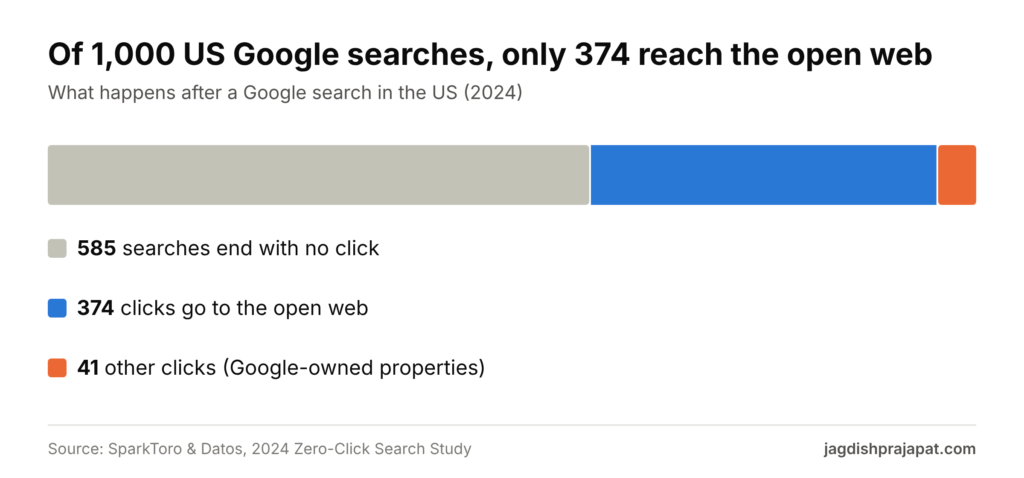
15. 58.5% of Google searches in the US and 59.7% in the EU end without a click.
Out of every 1,000 searches, only 374 clicks in the US (360 in the EU) reach a website not owned by Google. This data was collected before AI Overviews were widely available, so today’s figure is likely higher.
Source: SparkToro and Datos, July 2024
16. The #1 organic result has an average CTR of 27.6%, about 10 times that of the #10 result.
The top three results together get 54.4% of all clicks.
Source: Backlinko, 4 million search results (updated April 2025)
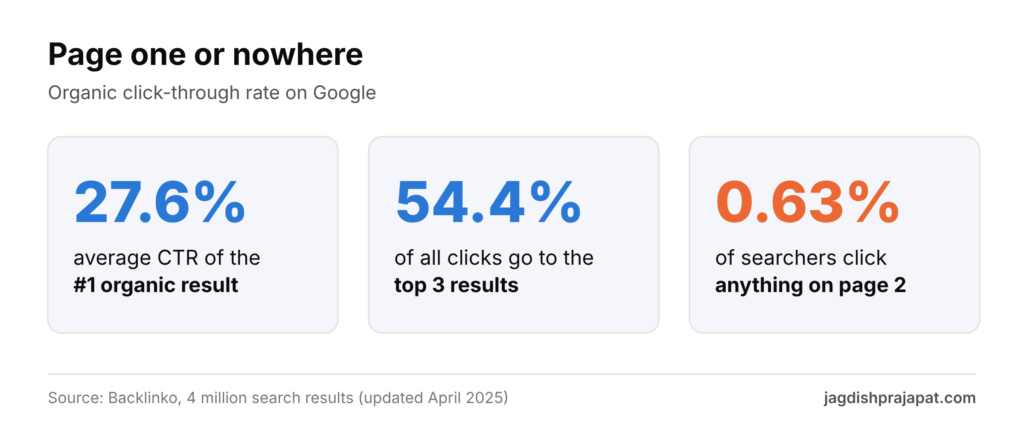
17. Only 0.63% of searchers click a result on page two.
If you’re not on page one, you’re effectively invisible.
Source: Backlinko (updated April 2025)
Content, links and rankings
18. 96.55% of web pages get no traffic from Google at all.
Another 1.94% get 10 or fewer visits a month. The usual reasons are no search demand for the topic, no backlinks, and not matching what the searcher wants. If backlinks are your gap, start with these link building strategies. This is still the latest large study on the subject.
Source: Ahrefs, ~14 billion pages, December 2023
19. The average #1 ranking page is about 5 years old, up from 2 years in 2017.
Established pages that are kept up to date keep their rankings, so updating an existing page is often better than publishing a new one.
Source: Ahrefs, 1.3 million keywords, May 2025
My take: Before you write a new post, check whether an existing page already targets that topic. Refreshing it with new data, better headings and stronger internal links usually works faster, because it keeps the age and backlinks the page has already earned. This guide covers the basics of optimising a page to rank.
20. Only 13.7% of top-10 ranking pages are less than a year old, down from 22% in 2017.
Source: Ahrefs, May 2025
21. Google released two core updates in the first half of 2026.
The March 2026 core update ran from 27 March to 8 April, and the May 2026 update from 21 May to 2 June. A steady rhythm of core updates is why SEO needs ongoing work rather than a one-off fix.
Source: Search Engine Roundtable, June 2026
What marketers are doing
22. 27% of marketers say their website, blog and SEO deliver the highest ROI of any channel.
That puts it at #1, just ahead of paid social (26%). You can estimate your own return with this SEO ROI calculator.
Source: HubSpot State of Marketing Report 2026
23. Over 92% of marketers already optimise, or plan to optimise, for both traditional and AI-powered search.
Source: HubSpot State of Marketing Report 2026
24. Nearly 30% of marketers say their search traffic has fallen as consumers move to AI tools.
Source: HubSpot State of Marketing Report 2026
SEO statistics for India
25. Google has 96.63% of the search market in India, compared with 88.67% worldwide.
Bing has just 1.92% in India. For Indian businesses, Google really is the whole game.
Source: StatCounter Global Stats, September 2026
26. 77.3% of web traffic in India comes from mobile, against 58.99% worldwide.
Desktop accounts for 22.1% and tablets 0.6%. Most of your Indian visitors will see your site on a phone, often over a patchy connection.
Source: StatCounter Global Stats, September 2026
My take: Test your key pages on a mid-range Android phone on a 4G connection, not on your office Wi-Fi. For local SEO in India, a fast mobile page with a tap-to-call button and an up-to-date Google Business Profile matters more than anything on desktop.
27. India had 886 million active internet users in 2024 and was expected to pass 900 million in 2025.
Rural India now accounts for 488 million users, 55% of the total, and is growing twice as fast as urban India.
Source: IAMAI and Kantar, Internet in India report, via The Week, January 2025
28. 98% of Indian internet users access content in Indian languages.
Even in cities, 57% of users prefer content in regional languages. Tamil, Telugu and Malayalam are the most widely used.
Source: IAMAI and Kantar, via The Week, January 2025
My take: Look in Search Console for Hinglish and regional-language queries you already get impressions for. Queries like “best sunscreen for dry skin ke liye under 500” often have far less competition than their English equivalents. For city-level targeting, see my guide to hyperlocal SEO.
29. India is Google’s largest market for both voice and visual search, and AI Mode now works in Hindi and seven other Indian languages.
AI Mode added Hindi in September 2025, then Bengali, Kannada, Malayalam, Marathi, Tamil, Telugu and Urdu in October 2025. India was also the second country, after the US, to get Search Live, which lets people search by talking and pointing their camera.
Source: Google, via TechCrunch, October 2025
30. 86% of Indian shoppers who use Search are open to trying new brands or products.
Among Indian users of AI Overviews or AI Mode, 84% say it helps them decide faster and 87% say they feel more confident in their choices. This is a real opening for challenger brands that show up in AI answers.
Source: Google/Ipsos via Think with Google, December 2025 surveys
Myths and outdated claims I’ve removed
| Old claim | What is true in 2026 |
|---|---|
| “Google uses over 200 ranking factors” | The number traces back to around 2009, when Google’s Matt Cutts mentioned “over 200 variables”. Google has changed its algorithm thousands of times since and has never published a list (Search Engine Journal). Focus on relevance, quality, links and user satisfaction rather than counting factors. |
| “Bounce rate is a ranking factor” | Google’s John Mueller said that the idea Google uses Analytics bounce rate for ranking is “definitely not the case” (Search Engine Roundtable, 2020). What Google does use is aggregated click behaviour on its own results pages. A system called NavBoost was confirmed in the 2023 US DOJ antitrust trial, and click signals appeared in the 2024 leak of Google’s API documentation (Hobo Web). |
| “Keywords in your domain name help you rank” | John Mueller: “There’s no secret (or public) SEO-bonus for having your keywords in the domain name” (Search Engine Journal, 2022). A memorable brand name is worth more. |
| “Longer content ranks better” (2,416 words) | Google’s own guidance asks whether you’re writing to a word count because you think Google prefers one, and answers “No, we don’t” (Google Search Central). Cover the topic completely and get to the answer quickly. |
| Voice search word counts and load times | These figures came from a 2018 study. Fewer than 10% of marketers optimise specifically for voice (HubSpot, 2026). |
| “Mobile ‘best’ + ‘right now’ searches grew 125% in 2019” | This is pre-pandemic data and no longer relevant. |
What these statistics mean for your SEO in 2026
- Optimise to be cited, as well as to be clicked. Answer the main question in the first 1–2 sentences under each heading, use clear structure, and add schema so AI Overviews and ChatGPT can quote you. This is what answer engine optimisation (AEO) focuses on.
- Measure more than rankings. As clicks fall, track impressions, branded searches, AI referrals in GA4, and leads. These SEO tools that experts use make the tracking easier.
- Update your best pages instead of only publishing new ones. Established pages hold the top positions (stats 19–20).
- Build your brand alongside backlinks. People who already know your name click your result even when an AI answer sits above it.
- Don’t neglect images and products. With 25 billion Lens searches a month, visual search is a real traffic channel.
- In India, write for mobile and mixed languages. 77.3% of traffic is mobile and 98% of users read content in Indian languages (stats 26 and 28).
FAQs
Is SEO still worth it in 2026?
Yes. Google handles more than 5 trillion searches a year, and marketers still rank website, blog and SEO as their top ROI channel. What has changed is how you measure success, which now includes visibility in AI answers as well as clicks.
Do AI Overviews kill organic traffic?
They reduce clicks on informational queries. Ahrefs measured a 58% drop for the #1 result. AI Overviews mostly appear on informational searches, so commercial, local and brand searches tend to be hit less. Pages cited in AI Overviews still gain brand visibility.
Which search engine should Indian businesses focus on?
Google. It has 96.63% of the search market in India, and AI Mode now works in Hindi and seven other Indian languages. Make sure your site is fast on mobile, because 77.3% of Indian web traffic comes from phones.
How much traffic comes from ChatGPT and other AI tools?
Across 101,574 websites, AI platforms sent 0.32% of traffic in 2026, but that share is growing quickly. ChatGPT sends about three-quarters of it.
Want to know how these trends affect your website? Book a free SEO audit call, or if you’d rather learn to do it yourself, start with how to become an SEO expert.
